
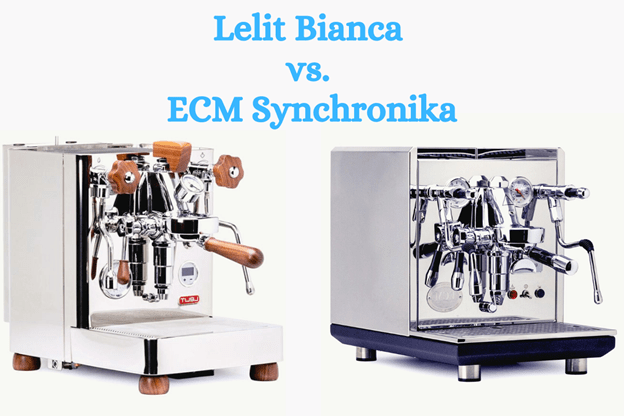
If you’re shopping in the prosumer espresso machine world (around $2,500–$3,500), the Lelit Bianca and ECM Synchronika are two of the most talked-about options. Both can pull excellent espresso — the real question isn’t which one makes better coffee, but which one fits your style of making it.
The Short Answer
Both machines deliver equally high-quality espresso. The real difference comes down to workflow philosophy, not cup quality.
If you love having maximum control over every part of the extraction and enjoy experimenting, the Lelit Bianca is usually the better pick thanks to its built-in flow control.
If you want rock-solid reliability, thermal stability, and a simpler, more consistent daily routine, the ECM Synchronika often wins because of its heavier build and refined engineering.
They actually share a very similar foundation — dual boilers, rotary pumps, PID temperature control, and the classic E61 group head. So the espresso quality gap usually comes down to how you like to work, not hardware limits.
Why This Comparison Matters
At this price point, most prosumer machines start to look pretty similar on paper. They all have:
- Dual boilers for brewing and steaming at the same time
- Rotary pumps for quiet, stable pressure
- PID controllers for precise temperature
- E61 group heads for great thermal inertia and mechanical pre-infusion
Because the baseline performance is already so high, the decision shifts from “which makes better espresso” to “how do I want to make espresso every day?”
It basically comes down to two mindsets: Instrument (repeatable and reliable — Synchronika) vs. Experimental platform (flexible and controllable — Bianca).
Core Concepts You Should Know
The E61 Group Head This decades-old thermosyphon design is still the gold standard. It keeps brew temperature stable by constantly circulating hot water.
While many people think E61 machines are automatically more stable, the truth is that thermal performance depends more on heat equilibrium time and how well the boilers are tuned. Newer versions like the Synchronika II even add group heating cartridges to speed things up and reduce the old warm-up drawbacks.
Flow Control vs. Pre-Infusion These are not the same thing. Pre-infusion gently saturates the coffee puck at low pressure. Flow control (Bianca’s star feature) lets you actively shape the entire pressure curve during the shot, which can help with channeling, light roasts, and even extraction of specific flavors.
The catch? More control also means more variables to dial in, and it makes your grinder’s consistency much more important.
How Each Machine Actually Works in Practice
Lelit Bianca
- Needle valve paddle gives you direct manual control over water flow rate
- Adjustable pre-infusion through pump pressure
- Movable water tank for easier kitchen placement
- LCC control panel for detailed tweaks
All that control gives you a higher ceiling for optimization — especially with light roasts — but it also adds complexity and dialing-in time.
ECM Synchronika
- Super stable thermosyphon loop
- Larger steam boiler (about 2.0 L) for better back-to-back milk drinks
- Integrated pre-infusion modes (especially on the Synchronika II)
- Heavier chassis that cuts down on vibration and pressure swings
Fewer variables mean more repeatable results and a smoother daily workflow.
Side-by-Side Design Philosophy
| Design Priority | Lelit Bianca | ECM Synchronika |
|---|---|---|
| Extraction flexibility | High | Medium |
| Workflow simplicity | Medium | High |
| Build density | Medium | High |
| Steam capacity | Medium | High |
| Experimentation ceiling | High | Medium |
| Default repeatability | Medium | High |
When Each Machine Really Shines
Bianca tends to outperform when you:
- Pull a lot of light roast espresso that needs a gradual pressure ramp
- Love experimenting with recipes
- Focus on single-origin optimization
- Enjoy diving into extraction science
Synchronika tends to outperform when you:
- Make lots of milk-based drinks
- Want a fast, predictable morning routine
- Prefer minimal adjustments
- Value long-term durability above all
A Quick Reality Check from Experience
Theory says pressure profiling should improve flavor clarity, especially with light roasts. In real life, though, the biggest challenge often shows up during grind calibration. Small changes in grind size can dramatically affect how the flow control behaves. Many owners end up dialing their grind a bit coarser than they would on a standard 9-bar machine to keep things stable.
Decision Logic Matrix
| Dimension | Bianca Advantage | Synchronika Advantage | Non-obvious Implication |
|---|---|---|---|
| Control vs cognitive load | Manual paddle experimentation | Predictable workflow | More variables increase dialing time |
| Thermal inertia vs responsiveness | Adjustable flow compensates temp drift | Heavy group stabilizes output | Different paths to consistency |
| Upgrade pathway | Built-in profiling | OEM profiling add-on | Cost distribution differs |
| Workflow speed vs flexibility | Slower dialing | Faster repetition | Matters for morning routine |
| Experimentation vs durability | More adjustable components | Simpler mechanical path | Fewer failure points |
Success Metrics to Watch
- Shot time variance — shows thermal and pressure stability
- Dial-in iterations — tells you how efficient your workflow really is
- Steam recovery time — important for milk drink throughput
- Warm-up equilibrium time — affects how quickly you can start your day
- Pressure curve stability — indicates how consistent your extractions are
Limitations and Risks
With the Bianca:
- Extra valve complexity can make maintenance a bit more sensitive
- More parameters mean a steeper learning curve
- Some owners end up not using the flow control as much as they expected
With the Synchronika:
- True profiling usually requires an extra purchase
- Heavier chassis makes it less flexible for moving around
- Part of the premium price comes from the refined aesthetics and build
FAQ
Is the espresso taste significantly different? Usually no. Real differences mainly show up when you actively use profiling techniques.
Is flow control necessary? Not necessary, but it can be very helpful for optimizing light roasts.
Which machine lasts longer? The Synchronika’s heavier build is often seen as more durable, though both are built for a long service life.
Which heats up faster? The Synchronika II pulls ahead with its group heating cartridges and faster warm-up modes.
Which is better for milk drinks? The Synchronika’s larger 2.0 L steam boiler gives it stronger sustained steam performance for back-to-back drinks.
Which is easier for beginners? The Synchronika usually requires fewer adjustments day-to-day.
Which machine is quieter? Both use rotary pumps, so they’re both relatively quiet in operation.
Final Thoughts
The Lelit Bianca and ECM Synchronika are two different interpretations of the same solid engineering foundation.
Choose the Bianca if you see espresso making as an adjustable, iterative process you enjoy experimenting with.
Choose the Synchronika if you want a reliable, repeatable workflow that just works with minimal fuss.
At this level, your espresso quality is rarely held back by the machine’s raw capability. It’s much more about how the machine fits into your daily routine and mindset.