
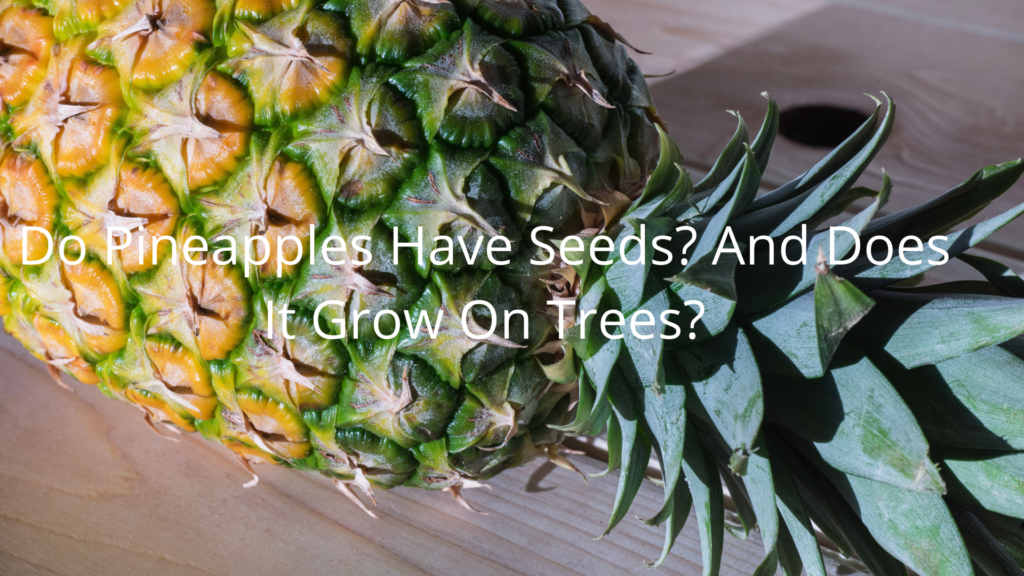
Yes, pineapples can have seeds, but most of the ones you find in stores are effectively seedless. They usually develop fruit without fertilized seeds. And no, they don’t grow on trees — they come from a short, ground-level herbaceous perennial plant.
Here’s the interesting part: “seedless pineapple” doesn’t mean the plant is biologically incapable of making seeds. It’s mostly due to self-incompatibility, lower fertility in the varieties we grow, and farming practices that avoid cross-pollination.
A pineapple isn’t a single fruit like an apple. It’s a multiple fruit formed from dozens of tiny flowers that fuse together as they grow. That’s why each “eye” on the skin is actually one of those individual fruitlets — it gives the whole thing that segmented, tiled look.
Pineapple plants belong to the bromeliad family. While some bromeliads grow on trees as epiphytes, the ones we eat grow right in the soil.
Most pineapples are grown from plant parts — crowns, slips, suckers, or shoots — rather than seeds. It’s faster, more reliable, and keeps the variety consistent. You’ve probably heard the advice to plant the leafy top, and it does work for home growers, but it’s not the only (or always fastest) way to get fruit.
One thing many people miss: commercial growers actually want to avoid seeds because they can make the flesh less pleasant and the fruit less uniform.
Industry Hub Mapping: Where This Topic Fits
Pineapple biology touches on several different areas that usually get discussed separately:
| Knowledge Hub | Connection to Pineapples | Why It Matters |
|---|---|---|
| Botany | Pineapple is a flowering plant in the bromeliad family | Explains why it has flowers, ovules, and potential seeds |
| Horticulture | Propagation relies mostly on crowns, slips, and suckers | Explains why grocery-store pineapples rarely show seeds |
| Agriculture | Commercial growers favor uniform, seedless fruit | Seedlessness affects market quality and processing |
| Food Supply Chains | Fruit size, sweetness, and uniformity influence grading | Seed formation can reduce eating quality and consistency |
| Home Gardening | Pineapples can be grown in containers from the crown | Useful, but slow and climate-sensitive |
The bigger takeaway? A pineapple isn’t “seedless” because it skipped reproduction. It’s seedless in the stores because plant biology and farming goals line up perfectly: we like smooth flesh, growers like uniform crops, and vegetative propagation keeps everything stable.
Direct Answer
Pineapples can produce seeds, but the ones sold in grocery stores usually don’t have any noticeable ones. Most cultivated varieties form fruit without successful fertilization, and farms typically grow new plants from cuttings instead of seeds. According to the Australian Office of the Gene Technology Regulator, cultivated pineapples are self-incompatible and typically parthenocarpic — meaning the fruit develops even without seeds forming.
And just to be clear, pineapples don’t grow on trees. The plant is an herbaceous perennial with a short, stocky stem and a rosette of stiff leaves, staying close to the ground. It usually reaches just a few feet tall.
Context: Why the Confusion Exists
You’ll often see a simple answer online: “Pineapples don’t have seeds and don’t grow on trees.” It’s easy to remember, but it leaves out some important botanical details.
Most of us picture pineapples as completely seedless fruits that somehow grow from the leafy top. The reality is more nuanced. The plant still produces flowers, ovules, and pollen, and it can make seeds if the right cross-pollination happens. The leafy crown can start a new plant, but commercial growers also use slips and suckers because they fit better with their schedules.
The “tree” mix-up makes sense — most big tropical fruits like mangoes, oranges, and coconuts come from woody trees. Pineapples break that rule. The fruit grows on a stalk rising from a low rosette plant.
The seed confusion comes from our eating experience. When you slice a pineapple into rings or chunks, you rarely (if ever) hit hard seeds. That’s real — but it’s more about how commercial pineapples are grown than any absolute rule of nature.
Core Concepts: What a Pineapple Actually Is
A pineapple is the fruit of Ananas comosus, a perennial in the Bromeliaceae family. It’s native to tropical and subtropical America.
Unlike an apple, which comes from one ovary, a pineapple develops from a whole cluster of flowers (an inflorescence). As the flowers mature, their individual fruitlets grow together into one compact fruit. That’s the reason for the tiled, segmented skin.
Each “eye” tells the story of one flower. So when we ask “where are the seeds?” we really need to think about all those individual fruitlets, not one central core.
If seeds do form, they’re usually small, hard, and dark, tucked near the outer flesh. You almost never see them in supermarkets, but they’re not impossible.
Mechanism: How Pineapple Seeds Form—or Don’t
Seeds only happen with successful pollination and fertilization. Pineapple flowers have the right parts, but many cultivated varieties are self-incompatible — their own pollen (or pollen from very similar plants) doesn’t usually work well.
Vegetative propagation explains how we multiply the plants, but seedlessness goes deeper: low fertility, self-incompatibility, and large monoculture fields that limit compatible cross-pollination all play a role.
Here’s a quick breakdown:
- Self-incompatibility: The plant’s own pollen often fails to produce seeds.
- Parthenocarpy: Fruit develops without fertilized seeds.
- Vegetative propagation: New plants come from crowns, slips, suckers, or shoots.
- Seedless fruit: The edible part usually lacks mature seeds, especially in stores.
The cool thing is that a pineapple can still be a “real” fruit even without seeds. In many plants, fruit and seed development are tightly linked. Pineapples are more flexible.
Does Pineapple Grow on Trees?
No. The fruit grows from the center of a low plant, on a stalk that emerges from a rosette of leaves. The plant is herbaceous — no woody trunk or branches like a tree.
The leafy crown can grow into a new plant, but the fruit itself forms on a mature plant’s central stalk. After harvest, the crown is just a handy propagation piece, not where the next fruit is “stored.”
Pineapple plants typically grow 3 to 5 feet tall and take about two years to produce fruit. Side shoots can then be used for more plants.
Comparative Evaluation: Seeds, Crowns, Slips, and Suckers
For home gardeners, the crown is the go-to because it comes free with your grocery pineapple. For commercial growers, the choice is practical: which material gives uniform plants, good timing, and consistent fruit?
Planting the top works, but it’s not always the fastest or most uniform option. Commercial operations prefer vegetative parts because they keep the exact same traits as the parent plant.
| Propagation Method | Speed to Useful Plant | Genetic Predictability | Practical Trade-Off |
|---|---|---|---|
| Seeds | Slow | Low | Useful for breeding, poor for predictable fruit production |
| Crown | Moderate to slow | High | Easy for home growers, but may take longer |
| Slips | Often faster than crowns | High | Useful where available, more common in production contexts |
| Suckers | Often vigorous | High | Can produce strong plants but depends on source plant health |
| Tissue culture | Scalable under controlled systems | High to moderate | Requires lab infrastructure and quality control |
Seeds are great for breeding new varieties because they create genetic variation — exactly what commercial production usually tries to avoid.
Proprietary Comparison Table: The Hidden Trade-Off
| Question | Simple Answer | Deeper Answer | Why the Simple Answer Can Mislead |
|---|---|---|---|
| Do pineapples have seeds? | Usually no | They can, but commercial fruit is usually seedless | It hides the role of pollination and cultivar compatibility |
| Are pineapples seedless naturally? | Yes | Partly natural, partly selected and managed | It ignores agricultural incentives for seedless flesh |
| Do pineapples grow on trees? | No | They grow on a herbaceous bromeliad near the ground | People may still misunderstand where the fruit forms |
| Can you grow pineapple from the top? | Yes | Yes, but crowns are only one vegetative method | Home advice is not the same as commercial practice |
| Is seedless fruit unnatural? | No | Seedlessness can arise through normal plant mechanisms | “No seeds” does not mean “not a real fruit” |
Downstream Impact
When pollination does happen in the field, it can create seeds that affect the quality consumers expect. Growers manage this by choosing cultivars carefully, controlling pollinator exposure, and planning field layouts.
This creates two very different goals depending on who you are:
| User | Desired Outcome | Pollination Preference |
|---|---|---|
| Breeder | Genetic variation | Encourage controlled crosses |
| Commercial grower | Uniform seedless fruit | Minimize unwanted cross-pollination |
| Home gardener | Any successful fruit | Usually does not need seeds |
| Consumer | Sweet, easy-to-cut flesh | Prefers no hard seeds |
Success Metrics Professionals Use
- Seed incidence per fruit: How often visible mature seeds appear — a sign of unwanted cross-pollination.
- Days from planting to harvest: Helps with scheduling based on propagation type.
- Fruit uniformity: Size, shape, maturity, and sweetness consistency for grading and retail.
- Propagule survival rate: How well crowns, slips, or suckers establish — affects costs.
- Soluble solids level (often in °Brix): Measures sugar content to decide when to harvest.
Practical Insights for Home Growers
That grocery-store crown can absolutely grow into a plant — but it takes patience. It often needs 18 to 24 months (sometimes longer) under good conditions.
The biggest mistakes aren’t about seeds — they’re rot from poor drainage, not enough light, or cold temperatures. Pineapples like warmth, bright light, and well-drained soil. They’re fairly drought-tolerant once established, but hate soggy roots in containers.
Pro tip: Trim away extra flesh from the base, let it dry a bit, and plant shallowly in a free-draining mix. Avoid dense garden soil or keeping it constantly wet.
Field Note: Practitioner Insight
In theory, crowns root easily. In practice, the tricky part is establishment — leftover fruit tissue on the base can rot in damp conditions. Trimming it clean and letting the base callus over helps a lot.
Timing is another challenge. Plants can look great for months before they’re big enough to flower, which makes consistent harvests tricky even for small growers.
Expert Disagreement: Seed Biology vs Crop Uniformity
Breeders love seeds because they’re the best way to create new genetic combinations and improve varieties.
Commercial growers, on the other hand, prefer the predictability of seedless, clonal plants — consistent size, ripening time, and texture matter more in the field.
Both views are valid. It just depends on the goal: variation for breeding, repeatability for production.
Limitations and Risks
“Pineapples don’t have seeds” is handy shorthand for everyday eating, but it’s not a universal botanical truth.
“Grow from the top” works great in the kitchen, but it’s only one method. The plant normally fruits from its central stalk.
Home-grown pineapples may also not match store quality. Light, temperature, pot size, nutrition, and the specific variety all make a big difference.
FAQ
Do pineapples have seeds inside? Most store-bought pineapples do not have noticeable mature seeds. Pineapples can produce seeds under compatible cross-pollination, but commercial fruit is usually seedless.
Where are pineapple seeds located? When present, pineapple seeds are usually small, dark, and embedded near the outer flesh associated with individual fruitlets. They are not arranged in a central core like apple seeds.
Why don’t grocery-store pineapples have seeds? Cultivated pineapple varieties are commonly self-incompatible and are usually grown in ways that favor seedless fruit. Growers also propagate plants vegetatively, so seeds are unnecessary for routine production.
Do pineapples grow on trees? No. Pineapples grow on a short herbaceous perennial plant near the ground, not on a woody tree.
Can I grow a pineapple from a pineapple top? Yes. The leafy crown can root and grow into a new pineapple plant if planted in warm, bright, well-drained conditions.
How long does it take to grow a pineapple? For home growers, it commonly takes about 18 to 24 months or longer for a pineapple crown to mature and produce fruit under suitable conditions.
Is pineapple a berry? Botanically, pineapple is better described as a multiple fruit made from many fused flowers and fruitlets. It is not a single berry in the everyday sense.
Is a seedless pineapple genetically modified? A seedless pineapple is not automatically genetically modified. Seedlessness in pineapple commonly results from plant reproductive biology, cultivar selection, and production practices.
Conclusion
Pineapples can have seeds, but most commercial ones are seedless because the varieties we grow often develop fruit without fertilization and are multiplied from plant parts instead of seeds. They also don’t grow on trees — they come from a low-growing herbaceous bromeliad with a central fruiting stalk.
The more accurate picture is this: pineapples are flowering plants that can make seeds, but the fruit we buy is carefully managed and selected to stay seedless. That simple distinction explains both the fascinating biology and what we see in the produce aisle. Happy growing!